How Proteins Are More Like LEGO Than JENGA: A Revolutionary Discovery
Imagine trying to build a 60-piece puzzle—but instead of just one correct way to assemble it, there are 10⁷⁸ possible ways to fit the pieces together. That staggering number—a quinquavigintillion—is roughly the number of combinations even a short protein could theoretically adopt, almost matching the total number of atoms in the known universe
So how has evolution managed to pick only those rare combinations that both fold properly and remain stable enough to function in living organisms?
The Experiment That Shook Protein Science
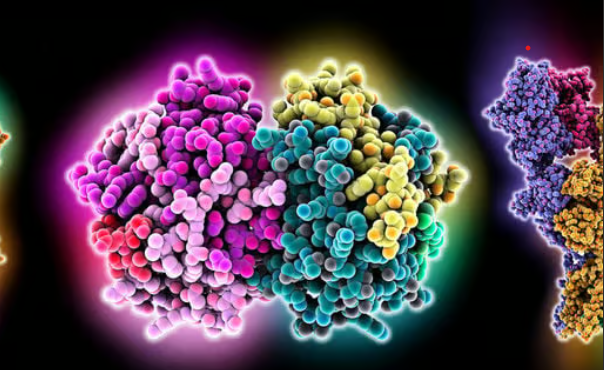
Scientists from the Centre for Genomic Regulation (CRG) in Barcelona and the Wellcome Sanger Institute in the UK embarked on a bold experiment. They focused on an essential protein fragment known as FYN-SH3, a domain about 60 amino acids long that plays vital roles in signaling pathways (Wikipedia – SH3 Domain).
Using high-throughput lab techniques, the team generated hundreds of thousands of different FYN-SH3 variants, testing which could still fold correctly and work as intended (Cambridge Independent).
Surprisingly, most variants retained their shape and function—even when many of their amino acids were altered!
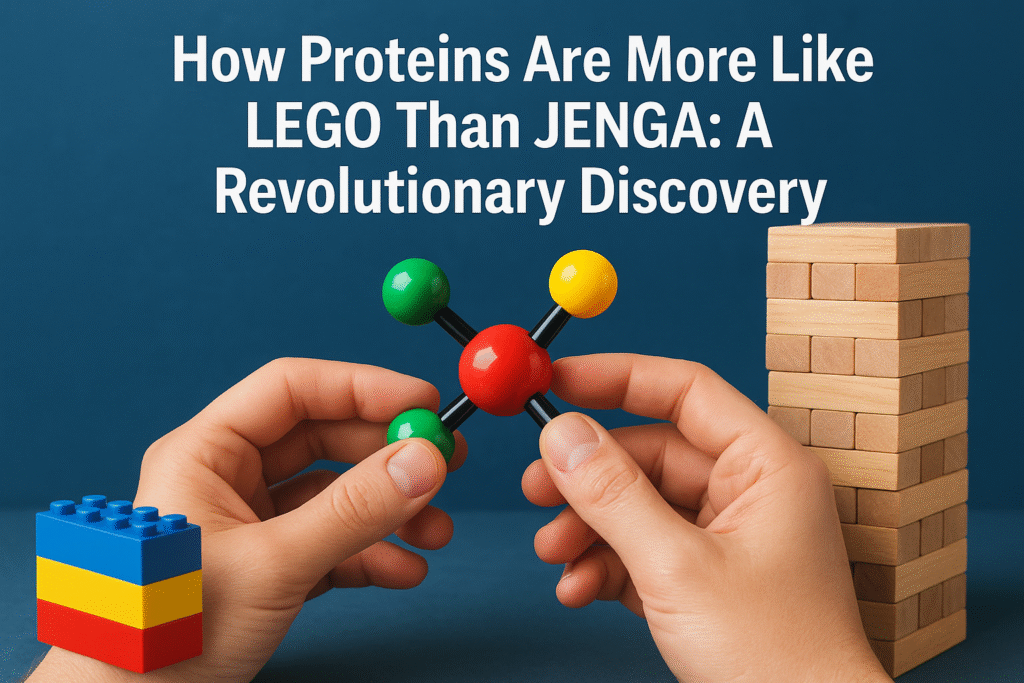
Only a handful of “load-bearing” amino acids in the core were critical to stability. The rest behaved more like LEGO bricks—stable and modular, rather than fragile load-bearing supports like JENGA blocks.
From Data to Evolutionary Insight
The researchers fed all that experimental data into machine learning models. They trained an algorithm to predict whether any given SH3 sequence would stay stable, and tested it against over 51,000 natural SH3 sequences spanning bacteria, plants, insects, and humans (CRG News, Cambridge Independent).
Even sequences that shared less than 25% similarity with the human SH3 domain were correctly flagged as stable. This shows that the rules for protein folding are not narrow or fragile—they’re broad and forgiving. Evolution didn’t have to search the entire “sequence universe” but instead worked within a robust, rule-bound landscape.
Why It Matters: Faster, Smarter Protein Design
Protein engineers have long been cautious about tweaking critical parts of a protein—especially the core—because it was assumed that even minor changes could cause collapse.
But this study flips that assumption. The findings suggest we can now design proteins—enzymes, catalysts, therapeutics—with bolder modifications and still achieve stability (Genetic Engineering & Biotechnology News).
Potential impacts include:
- Therapeutics – modifying enzyme surfaces to avoid immune reactions.
- Industrial biotechnology – creating greener, faster catalysts.
- Vaccines & drugs – shifting from trial-and-error lab work to computational design.
As Professor Ben Lehner notes, this could enable “designing biology at industrial speed.”
Putting It All Together
| Old View (JENGA) | New View (LEGO) |
|---|---|
| Proteins are fragile—one change can wreak havoc | Most parts are modular—few critical points |
| Evolution must pick carefully from huge pools | Biochemical rules greatly simplify the search |
| Protein design requires slow, cautious tinkering | We can apply bold, predictive design strategies |
This breakthrough—published in Science on July 24, 2025—overturns the idea that protein cores are too risky to alter, showing instead a far more adaptable and predictable framework for both nature and human design (Wellcome Sanger Institute).
Final Thoughts
- This discovery helps explain how evolution found functional proteins from astronomical possibilities.
- It accelerates the design of new medicines, enzymes, and catalysts.
- It opens the door to a new era of bold, computationally guided protein engineering
Reference: “Genetics, energetics, and allostery in proteins with randomized cores and surfaces” by Albert Escobedo, Gesa Voigt, Andre J. Faure and Ben Lehner, 24 July 2025, Science.
DOI: 10.1126/science.adq3948