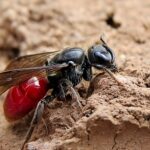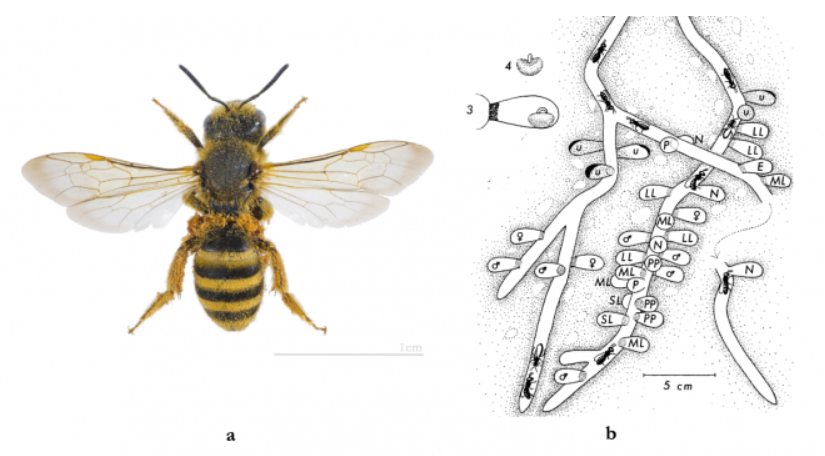

In the quiet patches of bare ground, beneath sunlit slopes and amidst sparse vegetation, an intricate world thrives just below our feet. The Halictidae family, commonly known as sweat bees, are master architects of subterranean nests, crafting complex tunnel networks that reflect both evolutionary precision and environmental adaptability.
Recent studies have illuminated the diverse nesting patterns of halictid bees, revealing how their subterranean dwellings vary remarkably across species, soil types, and climates. Typically, a Halictid nest begins with a primary vertical shaft descending into the soil, branching into lateral tunnels that house individual brood cells. While some species dig modest nests only a few centimeters deep, others construct elaborate networks extending over a meter beneath the surface, offering protection from predators and environmental fluctuations (Lybrand et al., 2020).
Soil composition, moisture levels, and temperature significantly influence nest design. Halictid bees generally prefer loose, well-drained soils but display a remarkable ability to adapt to sandier or denser substrates. Sunlit, south-facing slopes with minimal vegetation are often chosen to optimize warmth and facilitate excavation, a strategy critical for species survival in varied habitats (Simon & Pat, 1997).
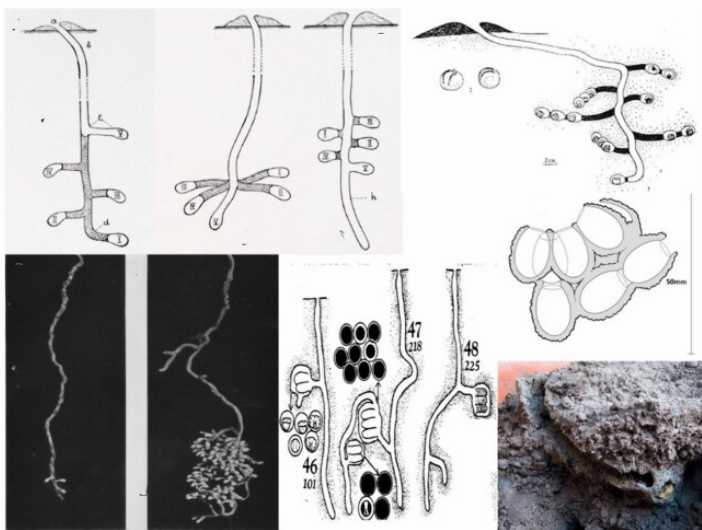
Inside these nests, female bees craft 10 to 15 brood cells, each provisioned with a pollen and nectar ball, upon which a single egg is laid—a method known as mass provisioning. These cells are sealed until the next generation emerges. Interestingly, brood cells located near the nest entrance tend to develop into males, who emerge first to await the later appearance of females. This emergence timing can vary from a week to over a year, depending on environmental conditions.
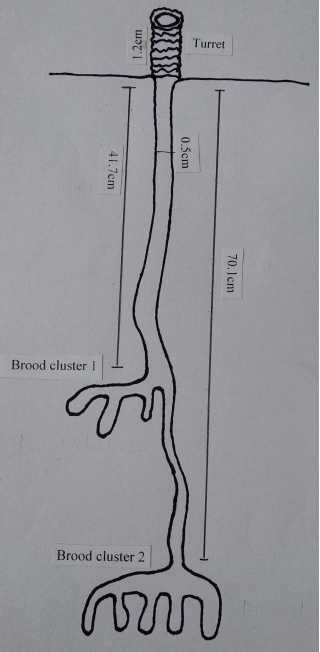
Overwintering strategies differ among halictid subfamilies. In Rophitinae, only females overwinter, while in Nomioidinae, both sexes endure the cold months. Halictinae and Nomiinae, however, restrict overwintering to mated females. These females emerge in spring, resume nesting activities, and provision new brood cells, perpetuating their species’ life cycle. Detailed observations of Nomiinae bees reveal nests with turrets, main shafts plunging 60–70 cm deep, and clusters of oblique brood cells. These nests, meticulously designed, offer formidable defenses against predators and environmental stressors. Female bees (2–5 per entrance) fiercely guard their brood, and some species even exhibit communal nesting behavior (Cosarinsky & Roces, 2012).
Meanwhile, Nomioidinae bees opt for shallower nests, often only 15–20 cm deep, featuring rough, unlined tunnels with horizontal side branches leading to brood cells. These bees frequently reuse old nests, a practical strategy in environments where time and resources are limited (Eickwort, 1978).
The Rophitinae subfamily showcases unique nesting behaviors, often choosing sloped landscapes for excavation. Their nests feature horizontally or obliquely positioned cells, intricately lined with waterproof coatings of sand grains and secretions, providing robust protection against moisture infiltration (Dar et al., 2023).
Halictinae bees, known for their social flexibility, construct nests with circular entrances, branching side tunnels, and radially arranged brood cells. Unlike rigid caste systems found in honeybee colonies, Halictinae social roles are fluid; older females may guard the nest while younger ones forage. Remarkably, even foraging females may retain reproductive capabilities, reflecting a dynamic balance between solitary and communal living . While parasitism is relatively low, with occasional mite and protozoa infestations, kleptoparasitic Sphecodes bees seldom invade Halictid nests. The architectural design of these nests deep brood placements, narrow tunnels, and guarded entrances—acts as a natural defense mechanism against intruders (Dar et al., 2017).
As we uncover more about these unsung pollinators, their nesting strategies reveal a story of resilience, adaptability, and evolutionary ingenuity. The Halictid bees’ underground world, though often overlooked, plays a crucial role in sustaining ecosystems and deserves a spotlight in the broader narrative of biodiversity conservation.https://doi.org/10.1111/1748-5967.70047